Augmented & mixed reality (AR/MR)

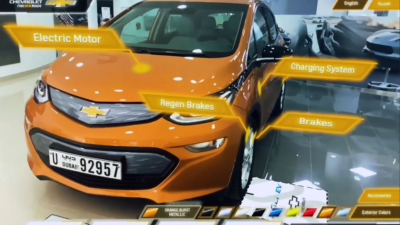
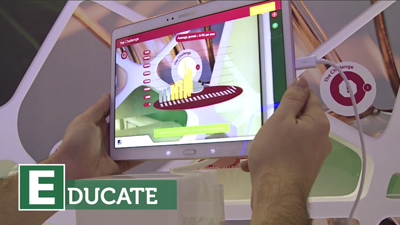
What you see is what you get… until our augmented or mixed reality application kicks in, superimposing information that is not really there. We make any environment, product, machine or other object come to life and present the user with multimedia content.

On your marker, get set, go

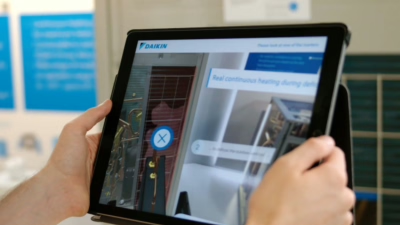
Augmented Reality (AR) relies on recognizing markers to trigger the appearance of extra information. The marker determines what to show and anchors the content to the real world. Markers can be positioned strategically in an area or on an object. They can be any distinctive feature or image that can be recognized by the image processing.

Positioning in the mix

Mixed Reality (MR) headsets or glasses scan the environment and keep this 3D space in the right perspective as you move. This ensures that virtual objects added to the environment remain correctly tracked and positioned, without the need for markers. This opens up a world of possibilities for user guidance, interactive help and call-out information, based on the real environment.

High-quality content

As we offer a one-stop-shop approach to content development, our teams can not only create the required AR or MR application, but all the content that goes inside. Whether it’s video production, graphics design or 3D/infographics/cartoon animation, we have the people and the tools to make sure your customers will enjoy a highly attractive journey.

Interactive too

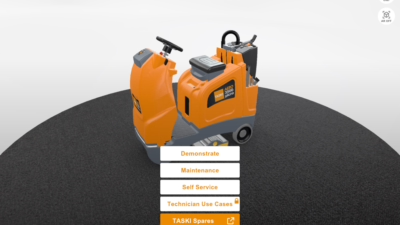
AR/MR apps can tell a whole story, offering users an interactive experience with many levels of information, drop-downs, selectors... Examples range from an AR/MR configurator, simulator or working principles demonstrator, to a whole training or sales tool. 
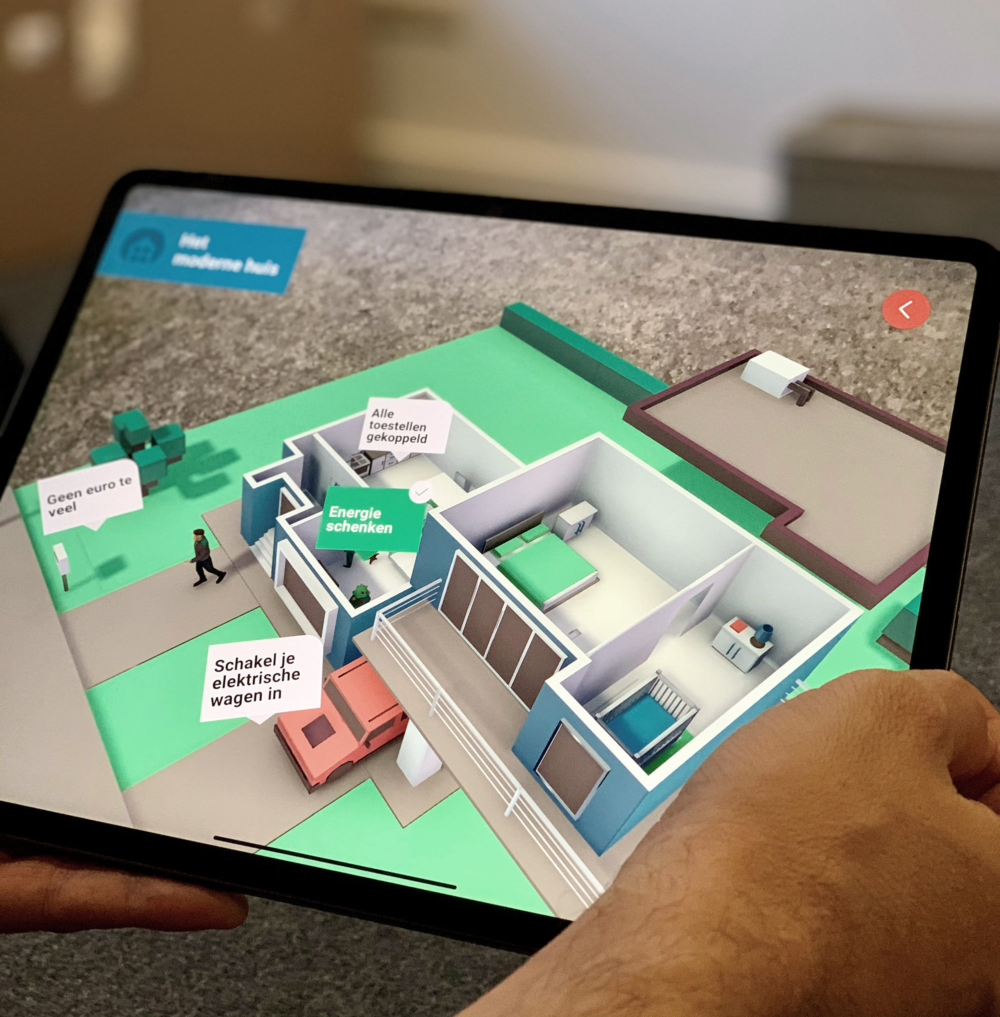
Augmented Reality app Fluvius home

Consulting services

Augmented and Mixed Reality are still evolving as a technology. The line between AR and MR is blurring with newer headsets, tablets are getting better at location accuracy and glasses are built in smaller and lighter form factors that stimulate a wider acceptance.
The decision to embark on this technology should be taken in an informed manner. Our consultants are ready to discuss your project and help determine which technology best answers your need, whether it is one of the devices to come, or an AR/MR product that is currently widely available.

Examples

Frequently asked questions

What is Augmented Reality (AR)?

Augmented Reality is a technology that overlays digital information—like 3D models, images, text, or animations—directly onto your real-world surroundings. Unlike experiences that shut out the physical world, AR uses a device's camera and screen (like a smartphone, tablet, or smart glasses) to blend computer-generated graphics seamlessly with the environment you see right in front of you.

How does AR work?

AR relies on a combination of hardware and software to place digital assets in the real world:

  • Sensors and Cameras: These scan your environment to detect depth, physical objects, and light.
  • Computer Vision (SLAM): Short for Simultaneous Localization and Mapping, this software allows the device to map its surroundings while keeping track of its own location within that space in real time.
  • Rendering: Once the device understands the physical environment (like finding a flat tabletop), it renders the digital object so it sits naturally in that space, complete with realistic lighting and shadows.
What is Mixed Reality (MR)?

Mixed Reality (MR) is a technology that merges the physical and digital worlds, allowing real and virtual objects to co-exist and interact in real time.

While AR simply displays digital content on top of your view, MR is fully context-aware. Digital objects in an MR space "know" where physical objects are. They can sit on top of, go behind, or physically react to your actual furniture, walls, and hands.

How does MR work?

MR relies on advanced sensors, cameras, and processing power to understand physical geometry. Key technologies include:

  • Spatial mapping: The headset continuously scans the room to create a invisible 3D mesh (map) of your environment—understanding where your floor, ceiling, tables, and chairs are.
  • Occlusion: This is the ability of a physical object to block your view of a digital one. If a virtual dog runs behind your actual couch, you won't see it until it emerges from the other side.
  • Gesture and eye Tracking: Instead of relying on hand controllers, MR headsets often use external cameras to track your hands and eyes, letting you "pinch" or "swipe" digital objects directly in the air.
What is Extended Reality (XR)?

Extended Reality (XR) is simply the umbrella term that covers AR, VR, and MR altogether. Think of XR as the family name, and AR, VR, and MR as the individual siblings.

What are typical applications for AR/MR in sales and marketing?

B2B sales reps selling large, heavy, expensive, or highly customized equipment (like medical MRI machines, industrial HVAC units, or factory robots) cannot bring a physical sample to a client's office.

With AR, using a tablet or phone, the sales rep can place a photorealistic, true-to-scale 3D model of the equipment directly into the client's office or factory floor.

Clients can physically walk around the machine, see how it fits their space, and understand its layout, and get detailed information of features and benefits.

What are typical applications for AR/MR in training and onboarding?

Traditional classroom or video training often fails to build muscle memory, while training on real, active machines carries safety risks and takes expensive equipment offline.

With AR, trainees interact with a physical machine while digital guides walk them through simulated breakdowns, emergencies, or maintenance procedures in a safe, controlled way.

What are typical applications for AR/MR in operations and manufacturing?

Assembly and Quality Assurance (QA)

In complex manufacturing, technicians traditionally had to look back and forth between a physical part and a massive paper manual or screen. AR overlays digital, step-by-step assembly guides directly onto the physical parts.

"Vision picking" in logistics

In massive warehouses, AR smart glasses act as an in-eye navigation system, highlighting the exact shelf and showing the worker the quantity to grab. This speeds up the picking process while ensuring near-perfect accuracy.

What are typical applications for AR/MR in maintenance and repair?

"See-what-I-see" remote assistance

When an expensive piece of equipment breaks down, the cost of downtime can be huge. Instead of waiting days for a specialized engineer, local technicians can wear AR glasses and connect with the expert remotely.

IoT-integrated preventive maintenance

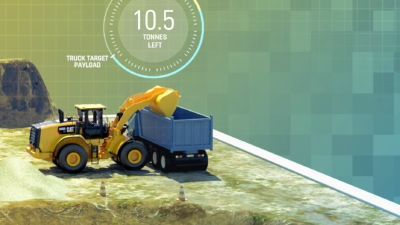
By pairing AR with the Industrial Internet of Things (IIoT), field technicians can walk up to an industrial asset (like a compressor or generator) and see its internal diagnostic metrics floating in the air next to it.

Related technologies

Virtual reality (VR)

We let your users interact with your company, products or services in your own corporate metaverse.

Interactive installations

We deploy a broad spectrum of interactive technologies to convey your message in an exciting way.​

All technologies